
|
| |
| |
 |
 |
The IMSAI
Series Two project...
Our focus has been to make the Series Two line
compatible with legacy IMSAI hardware wherever practical. As
such, much of the new sheet metal is compatible with the
original IMSAI 8080 Microcomputer system and variants, so users
can upgrade their older systems as they see a need or application.
The unique programmable front panel brings
control and display extensions via switches and LEDs to the user
environment. This, plus the ability to accommodate a
contemporary PC motherboard and peripherals, as well as the
benefit of USB and ethernet connectivity makes the IMSAI Series
Two system a powerful and flexible platform with which to build a
personal computer customized to YOUR needs and demands
Since we first announced our intentions to
build and offer the IMSAI Series Two system, feedback from
potential users have suggested a number of applications
including:
Educational
applications- The IMSAI Series Two provides a
powerful environment for teaching computer basics, embedded
controller design and testing, tactile display and control for
emulation, and more...
The
Hobbyist market- Experimenters and hobbyists
wishing to have a reliable and customizable platform for testing,
debugging, and implementing embedded control designs, legacy, and
custom hardware will find the IMSAI Series Two to be a viable and
capable system to help meet their goals
Industrial
and Commercial Control- The unique
programmable front panel of the IMSAI Series Two affords OEMs and
designers an adaptable and easily customized interface for
PC-based and custom controller designs in an industrial grade
cabinet capable of rack-mount and stand-alone configurations.
The front panel film mask may be easily modified to meet the needs
and branding that might be required for a specific application
The
"Vanity" market- Think of it as a new "skin"
for your computer! The IMSAI Series Two offers an unique,
attractive, and practical alternative to housing your PC hardware.
Programmable front panel LED displays and switches allow for
user-configurable control and display. Flip a switch to
bring up a specific application, flash one or more LEDs to
indicate an alert or process. Limitless possibilities exist,
bound only by your imagination!
These goals and others will be developed as we
work with new resources and opportunities. Stay tuned!

The new IMSAI Series Two full-length chassis shown with an
original IMSAI CPA Programmers Front Panel to illustrate
compatibility with legacy hardware |
|

Prototype version of the IMSAI Series Two USB |
|

Rear
View of the IMSAI Series Two SE
Note that power supply is optional and representative
only; not necessarily the style that will be supplied. |

Side
view of a typical ATX (PC) style motherboard installed in our SE "short"
chassis
All IMSAI Series Two SE base plates allow mounting of an ATX-style
motherboard OR an optional IMSAI 9-slot EXP-9/AT (S-100 bus)
motherboard for legacy system builders and owners. User-installed
Hard Drive is seen attached to back of sub-panel for fully contained
system.
Note that full length (standard IMSAI Series Two) base plates will
accommodate both ATX and EXP-9/AT motherboards in the same enclosure. |

Back
panel view of an example of an ATX (PC) style motherboard installation
(user-installed option) showing typical I/O panel cover plate (originally
supplied with most motherboards) and card expansion panel detail. |
|

Here's our new EXP-9/AT 9-slot, active-termination
S-100 bus motherboard, used in our IMSAI Series Two LE and FE systems, and
as an option for all Series Two chassies. It also can be used as an
exact replacement in older IMSAI chassies such as the IMSAI 8080 and PCS
systems, and clones that copied the IMSAI mounting arrangement..
Four surface-mount LEDs indicate available voltages (+8v,
+/-16v, +5v).
Supplied with 8 high-quality sockets and 18" long power
harness, the 9th slot (socket optional) is reserved for users of legacy
front panels that require direct connection to the backplane such as the
IMSAI CP-A Programmers Front Panel Price:
$285 (assembled) $230
(kit)
Additional socket (for 9th position): $9.50 |

View of the underside of the EXP-9/AT showing the Texas Instruments active
termination devices which feature a dynamic "weak pull-up" approach to
increasing backplane performance.
Provision is made for an External Reset connector and
regulated 5 volts (2 amp maximum load).
Featuring a generous ground plane guard band between bus
traces, precision active termination devices, and tested at bus speeds in
excess of 10 MHz., it is possibly the fastest and most reliable S-100
backplane design to date! |

Now
Available- Due to a number of requests over the
years, we're happy to announce the availability of the manual and
related documents for the
IMSAI 8048 Control Computer, also known as the IMP-48 and IMSAI
Express. This is compiled from several archival
documents and prints in our library and is available for $35.
It comes in a three-ring binder (just like the original) and
includes 11" x 17" copies of the Assembly diagram and schematic.
Printed on the same heavy paper as originally issued from IMSAI
Manufacturing. |
|
|
®
IN THE MOVIES

Everything you want to know
and more about the 1983 MGM film "WarGames"
Turner Classic Movies featured "WarGames" as one their
choices for the "31 Days of Oscar" program during February of 2008. Every
time I watch this I find something new! Director John Badham packed a lot of fun in
his brilliant take on the original script. Watch it again if you haven't
seen it in a while!
Want to build your own WOPR
replica, or buy one ready-made?
We will soon offer
full-size plans, materials, and drawings for building a copy of the original 1982 film prop
(based on scaling and construction details of the "AT&T replica W.O.P.R.").
Materials list and construction notes will make this set of plans a fulfillment
of requests we have received over the years from folks with a "different" sense
of reality!
A fully functional half-scale version of the original prop is currently in the
design and sourcing phase. Additionally, contacts and sourcing are in the
works with experienced Hollywood prop craftsmen who can supply the cabinetry.
We plan on supplying graphics, sheet metal and hardware, lighting controller,
and requisite "Good JuJu".
E-mail if you're
interested .
WOPR Replica Missing... or Stolen!

|
The W.O.P.R. Replica built for the
AT&T commercial two years ago sold on eBay May 28, 2008 for
$1,567.00.
|
Addendum:
The story of the WarGames replica W.O.P.R.
is gaining even further intrigue!

Backstory: In consideration of what I have
photographed at the time of the original AT&T commercial shoot two years
ago, experienced first-hand, and have been informed of since the
original "WarGames" 1982 shoot, I believe the story of the W.O.P.R. replica might
prove to be far more interesting than that of the original prop which was
scrapped shortly after the 1982 filming of "WarGames".
Although the cabinetry for the replica was executed in a
professional commercial display manner, the installation of inaccurate LED
lighting and a cheesy 10-channel controller to light them gave an unconvincing
imitation of the original. I was offered the opportunity of hauling this
particular item off after the 2006 commercial shoot where I provided the
original "WarGames IMSAI" and related props. I declined the offer due to
the bulk, some cosmetic damage incurred during the shoot, less-than-convincing
value, and consideration of the space required to store such a prop.
I was first contacted via e-mail in May by one "Marco",
who informed me in non-native English that "they" had it. Something very
clandestine and slimy came to mind as this individual was unable or unwilling to
give me any information as to how "they" acquired it after the shoot, and where
it was located. It almost seemed that "they" were holding it as hostage,
thinking I might dig deep into my pot of gold to provide ransom! I was
soon provided a grainy set of still images and a
link to youtube for a short
video showing it in operation, presumably in the dank recesses of its current
resting place. Evidence of peeling laminate and deterioration so
predictable was prominent, and my initial reaction that it might be better
served by shoveling landfill over the remains!
The prop later popped up on eBay, so I informed the Dutch
contact of this fact. He was ultimately the
successful eBay bidder for the replica W.O.P.R. At his request I made
contact with the Seller, a seemingly affable man who told
me he had no direct
contact or influence with the original construction efforts of early 2006 for the
AT&T "Voices" commercial campaign. According to
his story, he had rented space in his
building for the original construction crew who apparently built, then
ultimately abandoned this prop recently in lieu of rent.
The Dutch buyer contracted for me to travel to Los Angeles to
collect the prop, bring it back to my home near Sacramento, document it, prepare
and crate it for shipping, then take it to a Shipping Agent for shipment to
Holland where it would reside and be made available 24-hours a day via webcam.
I left home with my truck and trailer around midnight of
August 6 in order to drive the 450 miles to L.A. where I was to meet the Seller
and arrange to collect the prop. Unable to reach the Seller despite a
number of calls to his cell phone, I left messages stating that I would be there
early Wednesday morning. I finally reached him around 9:00 AM and told him
I was parked close to where he told me the prop was stored. He could not
(or would not!) remember the street address, but told me he would be down in
about 45 minutes.
I had earlier been in touch with Academy Award Winner ("The Golden Compass") Michael Fink who was Special Effects
Supervisor on the 1983 production of "WarGames", and he agreed to meet me to
swap stories and to get some photos of us together with the W.O.P.R.
He was even able to get his son to join us as a stand-in for the younger Mike
Fink to recreate the pose Mike took while crammed inside the original W.O.P.R.
with an Apple
][ in his lap and a 9" monitor in front of him, as Director John
Badham had him key control input for display of the one-of-a-kind fluorescent
display that served as the
W.O.P.R.'s countdown clock.
Mike and his son would not be there until around 11:30 AM, so
I continued to try to contact the Seller without success. Mike and his son
showed up on time and we spent several hours in the parking area where I waited.
We shared many stories of our respective involvement with production of
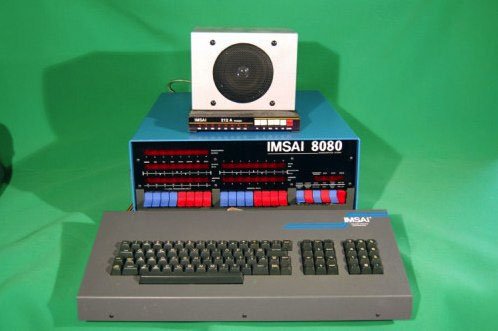
"WarGames", I brought along the original "IMSAI 212A MODEM", as well as my
collection of original communication with Mandy Films, MGM, and other
provenance. I also showed Mike and his son images I took of the
W.O.P.R. during the AT&T
commercial shoot. This was the first time we had ever met face to face,
and it was truly joyful and rewarding
experience for all of us.
Shortly after Mike and his son left, the Seller called me back
and said that he couldn't get there until 6:00 PM. I had no choice but to
continue to stay where I had been for the past 5 hours and wait it out. As
7:00 PM arrived and still a no-show, I called and left a message yet again.
At around 7:30 PM he called back and told me that "the landlord of the building
where the W.O.P.R. was stored had changed the locks and demanded $600 for back
rent, that he didn't have the money, and I could not get the W.O.P.R. that
night."
I was furious that he had lied to me and kept me strung out
for over 11 hours! I told him that I would let the Dutch Buyer know and
hung up. I was determined to drive back to Sacramento immediately, despite
having been up for 20 hours and facing a 7-hour drive home. I finally
arrived home around 3 AM, tired and disgusted, and e-mailed the Buyer later that
morning of the situation.
At this point we must conclude that the W.O.P.R. is missing
and presumed stolen. The possibility also exists that the Seller resold it
to another after being paid by the original purchaser. The Dutch group is
pursuing matters from their end, and I will provide whatever support I can here
in California. It is hoped that we can successfully recover this item and
resolve this issue. Meanwhile, a dirt bag named "W.O.P.R. Michael
Webb" continues
to slither the streets of Los Angeles
and...
Punk'd by Wired-
I completed delivery of the "WarGames IMSAI" and
related props (including the loan of an IMSAI FDC2-2 floppy disk drive
from my good friend Sellam Ismail at
www.vintage.org) for Wired Magazine's August edition coverage of
the Twenty-Fifth Anniversary of the original release. Despite
promise of reimbursement for my expenses in delivering the props to
their Oakland, California photographer's studio
for the shoot, and especially credits in the magazine, neither
happened.
In recent e-mails to and from
Wired's representative
Daniel Salo:
Hi Tom,
Sellam's credit (vintagetech.com) is on page 142 (on the right-hand
side), and the higher ups felt that Imsai was properly credited due to the
multiple mentions it receives in the photo caption and throughout the issue
("20-year
old Ally Sheedy was a lust object second only to the Imsai 8080").
-D
Hello Daniel-
I have to be honest and say "We got screwed by Wired". Had the
typeface been a point smaller, or the binding a fraction tighter, Sellam's
stipulated credit would be completely unreadable. As for me, I think your
"higher-ups" have their collective heads higher-up their asses. Getting stiffed
for my expenses in helping keep your production costs down by delivering the equipment to your photographer in Oakland is insult enough.
But to not get credit or mention that my firm is still active and not
an ancient anecdote is an affront that I don't take casually. Especially
when I recall giving my business card to your co-worker to ensure proper
credit!
Hello Daniel-
Despite your seemingly earnest concern, I still have to go back to
your earlier e-mail where you state :
"Don't worry, I'll make sure you and Sellam are properly credited.
Thank you both for all your help!
-D"
I'm worried as well as greatly disappointed in how neglectful your
firm has handled this entire matter which could have turned out so much better
for all of us.
Regards,
-Thomas Fischer
"Tom and Sellam,
I'm very sorry you feel this way. You know how much your efforts
meant to us, and even though it is against our policy to credit any website, I
fought for vintagetech and succeeded. The only other place we give credit
for any art in the magazine is on the bottom of the page, which is only
reserved for commissioned art.
In the only transaction we had regarding giving credit, I obeyed your
request. Please see below:
"Make sure Wired gives VintageTech appropriate credit! I'm not
expending
too much energy here for this loan but as you said it's a good opportunity
to get our collective names & identities out there. I know how these
media characters work: they are absorbed in their own duties and obligations
and often forget to give credit where it's due, so please impress on them
that I would be very chagrinned, very chagrinned indeed, if they did not
credit VintageTech -
http://www.vintagetech.com (yes, the URL included) for the hardware loan."
Initially, I put in the whole URL in the credit line, but our Copy
Chief would only do it if we removed the http. It was the only way of
getting in the credit, so I took it.
Being that this was the only discussion between you and I about crediting, there was no mention of crediting imsai.net.
Regarding reimbursement, your invoice was submitted to corporate and
is being processed. Unfortunately it's past business hours on the East
coast, but I will provide a status update for your tomorrow morning."
Reimbursement eventually came in the
form of a check without the previous "hoop in front of me to jump
through". Next time media knocks on my door, I'm getting a
contract in writing, and so is Sellam!
Twenty-Fifth Anniversary DVD digital release of
Wargames
I just received my copy of the new special 25th Anniversary wide-screen edition DVD of the film
WARGAMES from Fox Home Entertainment. It is a real treasure, packed with
behind-the-scenes stories and detail on the making and production of this true
film classic. I had thought the earlier Director's Cut
DVD would be the pinnacle of promotion for this 25-year old classic, but the
wizards of Hollywood seem to have devised something even greater! Release
date of the DVD version of the film was July 29 .
The IMSAI 8080 and related props get some great coverage and exposure in the
Special Features add-ons too! An added bonus is a "WarGames" Screen Saver
that uses images originally created for the Crystal Palace war room display
sequences. While never a fan of screen savers, this one hooked me!
Well worth the street price for a remastered version of a great film.
LATEST NEWS-
Wired Magazine
did a spread for their August 2008 issue on the 25th anniversary of the film "WarGames", and their people asked me to drag
out the old props and provide them for a photo shoot in Oakland, California. I'm always
a
sucker for publicity, so complied! Who'da thunk? I was skeptical
back in 1982 of the original concept but went along willingly. Most folks don't know
the story of how I created the forerunner of Proctor and Gamble's "Bounce"
fabric softener sheets in 1971, nor my creation of the first generation design
for PianoDisc, possibly the best piano player/recorder system in the world today
way back in
1987. But they do know me as the man who provided Matthew Broderick's
"Bedroom co-star" in the 1983 film "WarGames".
History Correction:
The "Voice" of
"Joshua"-
In the early version of the
"WarGames" script, the
W.O.P.R. prop was the military executive
mainframe responsible for the parsing and decisive coding necessary to
resolve scenarios presented to it. A common
misconception exists about the "voice" of "Joshua", reference to
Professor Falken's deceased son. The script implies that each
computer used in those scenes where we hear the "voice" has a voice
synthesis capability. Today's skeptics overlook the possibility
that a common voice protocol and parsing platform MIGHT have existed
at the time. For Heaven's Sakes, People... suspend disbelief
and remember, this is a movie!
How the effect was generated has been the
subject of speculation and assumptions rather than reality. No, the actual sound heard was not
produced using a VOTRAX, CompuTalker, or other computerized voice synthesizer of the
period as some folks believe. I reviewed my Director's Cut DVD version of "WarGames",
listening and taking notes on the Special Feature commentary of
writers Larry Lasker and Walter Parks, joined by
Director John Badham in preparation for an upcoming photo shoot
of the original "WarGames IMSAI" and related props.
James Ackerman is
listed on the film credits as "Joshua". Some folks and web sites
interpret that as meaning the "voice" of Joshua, rather than the child
actor seen in the simulated historical film clip depicting the assumed
deceased Falken in an earlier time. "Joshua" was the password
that character David Lightman intuits and subsequently uses to gain
access to the W.O.P.R. mainframe. The child actor's name is
James Ackerman, obviously too young to have voiced the special
effects sound track at the time.
Director John Badham states
in the commentary that the actor voicing the raw content that was
later modified for the computerized effect was John Wood (the
Falken character), reading the script word-for-word in reverse order
in order to portray a "flat quality" with limited inflection.
That raw audio was then edited and re-assembled after being run
through audio processing equipment to achieve the desired effect.
Verdict- The "voice" of "Joshua"
never existed per se. Joshua is the name of Falken's deceased son, and
was Falken's original password into the "back-door" of the W.O.P.R. mainframe.
The highly modified "voice" was created by the Sound Effects
Department from the vocalizations of actor John Wood.

A
commercial for AT&T's
"Voices" campaign was launched in March 2006, filmed on the
grounds of Playa
Vista Studios, former site of one of Howard Hughes' immense
airplane assembly hangars (a few miles north the Los Angeles International Airport), where
some of the most memorable technical props in modern film history were
assembled for a major commercial shoot.


I
provided the original "WarGames IMSAI" (and related props),
which is featured
in a starring role along with "Robby the Robot" from
the classic 1956 MGM film "Forbidden
Planet" (uh... that's me on the left!)...

"Rosie the Robot" (from
television's historic animated series "The Jetsons")...

and "K.I.T.T.",
the intelligent talking Pontiac from the "Knight Rider" television
series in AT&T's commercial campaign. More photos and story
coming up as soon!
The commercial clip
can be found on YouTube
here.
The original film release of "Forbidden Planet" in
1956 was one of my absolute favorites. I never imagined in my
wildest dreams that I might someday share Robby's space in place of
the lovely Anne Francis, as shown in the following image:
PLUS! ...
...
the answer to one of the most asked-about items
"What happened to the W.O.P.R.?"
Short answer is that it was scrapped
shortly after filming of the original movie. The back
story of the W.O.P.R as depicted in the original film
can be found here.
BUT...
3/18/2006 NOTE- A reproduction
of the original 1982 W.O.P.R. prop has been made and is featured with the
"WarGames IMSAI", "Robbie the Robot",
"Rosie the Robot" (from television's "The Jetsons"), and "K.I.T.T."
in an
AT&T
commercial that was filmed in Los Angeles. Photos and more on
the story will
post shortly)


|

George Allen Miles Jr.
aka...
Buddy Miles
-September 5, 1947-February 26, 2008...
a great boss, a great friend
My involvement in the 1960's San Francisco
Rock Music scene and eventual employment and friendship with Buddy laid
the threads and connections that would eventually make me a
participant of the early Silicon Valley rise of the "personal
computer revolution" and to IMSAI. I could write a book about the two years I
spent with Buddy and the adventures we had. I probably
will... LEFT: Buddy Miles
and Carlos Santana at the Sunshine '71 Crater Festival in Diamond
Head Crater, Honolulu, Hawaii (late December, 1971)
Don't know anything about
Buddy Miles?
Do you remember the
California Raisins commercials that ran on radio and television
back in the late 1980's? If you do, that's Buddy singing
lead vocal on " 'Heard It Through The Grapevine". Do
an internet search and you'll find plenty more about this
remarkable and understated performer who contributed so much to
pop music from the 1960's up until the time of his death.
Below are some available video clips on YouTube.com that
illustrate his talents as drummer, singer, and guitar player:
http://www.youtube.com/watch?v=XLLCTjIMmCs-
Buddy
performing with Carlos Santana (date and venue unknown, but
probably mid to late 1970's). I was with Buddy at his house
in Novato in late 1971 when he first called Carlos Santana and
proposed the idea of a surprise jam in Hawaii at the Diamond Head
Crater "Sunshine Festival". I was present for all prior
planning and efforts as well as the performance.
After the festival,
Buddy, myself, my cohort Richie, and Denise (Buddy's girlfriend at the time)
flew over to Maui where we happened to run into Barry Hilton
(Barron Hilton III) who subsequently invited us to join him in
sailing around the island. Absolutely unforgettable! I
still have a few photos that I took on stage during that jam.
Buddy's girlfriend at the time, Denise, later "borrowed" my 35 mm
slide photos, many taken during our memorable experience with
Barry Hilton for use in artwork for the cover of Buddy's upcoming "Chapter 7" album, but I never saw them again after that.
http://www.youtube.com/watch?v=WMOFPV4hQ_U&feature=related-
Buddy performing c. 1969 with Jimi Hendrix at the old Carousel
Ballroom, San Francisco. I believe it was in late 1968 or
early 1969 when Buddy played there again, second on the bill to
"Cream", and was determined to outperform Cream's drummer Ginger
Baker. In a wild and exuberant performance, arms flailing
with tightly gripped drumsticks, Buddy ended up knocking, then
kicking over his drum kit, never missing a beat, and finally
ending up sitting on his butt while pounding the remnant of his
bass drum with his fist. The crowd exploded with applause,
shouting, and whistling to affirm then and there the admiration
and acceptance for the explosive talent that this young performer
had so boldly exhibited! |
|
 |
 |
Two versions of our IMSAI Series Two SE "short" chassis.
This configuration is 6 1/2" shorter in depth than the full-length
IMSAI Series Two and original IMSAI 8080. It is otherwise identical in height and width
dimensions.
Lower
Left: Configured for S-100 bus with IDE hard drive
Lower
Right: Configured for ATX motherboard with IDE hard drive
How many IMSAI 8080's were made?
According to a July 2002 e-mail from the IMSAI 8080 creator Joe
Killian,
"I remember passing the 17,000 mark. I believe it never went past
20,000" [between December of 1975 and September 1979].
Fischer-Freitas Company produced another 2100+ machines between November
1979 and June 1986. These machines can be identified by the
Fischer-Freitas Company back panel label.
Systems produced after June of 1980 were supplied with the one-piece front
panel mask which consisted of a laminated Mylar mask assembly adhered to a
clear acrylic backing panel.
I have long stated that IMSAI produced more computer systems than any other
up until the closure of the founding company in 1979. My information
was based on an early communication from our old friend Stan Veit.
Before his death, Les Solomon (former Technical Editor for
Popular Electronics magazine) informed me (through mutual friend Stan
Veit) that he doubted over 12,000 Altairs were produced. Since no other
production estimates seemed to exist, it was from this statement that I made
my assumption.
Ed Roberts, founder of MITS (the firm that introduced the
pioneering Altair 8800) offers an opposing claim, excerpted from an e-mail
reply to IMSAI's former Chief Engineer Joe Killian after their first
communication ever on June 28, 2004. An excerpt follows:
(Ed Roberts:) "By the time the first IMSAI's appeared the
8800B was in production and was a significant improvement over the earlier
designs in a number of ways. For some reason the A and B seems
to have gone unnoticed in the history of personal computers even though
there were close to 30,000 of the B's manufactured. The
Altair 680 and its variants also have disappear into history even though
there were well over 10,000 of these models produced."
Until his first-ever contact with me on June 27, 2004, Ed Roberts has
remained relatively silent over the years regarding much of his early
history. I will continue to offer, as made available, additional
insight and clarification of the early Altair/Roberts history that may have
been omitted or mangled in other published histories of the beginnings of
the microcomputer industry.
I had copied the Roberts e-mail and my reply to
IMSAI creator Joe Killian, who then made the first-ever contact with
former mega-competitor Ed Roberts. Joe copied me on his e-mail
to Ed, and one of the more profound statements made by Joe speaks volumes of
the burgeoning growth that followed the introduction of the Altair:
(Joe Killian:) "Your card size, bus connector and signal
definitions were copied, by IMSAI, Processor Tech, and countless others,
either for complete systems or add-in boards. This was the sincerest
form of flattery, done because I and others saw supporting your design as
the best business path to pursue. I do think that this support in the
form of add-in cards and alternate platforms using the same bus was
fortuitous for all of us, in that it snowballed into the fledgling
industry's standard. I've always sort of felt that my choice of
using your bus, and thus IMSAI quickly being out there as a second MITS
compatible machine, tipped the balance on the part of all the others wanting
to enter the microcomputer market.
"Without such a standard, I would guess that neither MITS nor the
industry would have taken off nearly so quickly. Nothing else from
your machine was copied in the design of the IMSAI (save the use of the 8080
chip, of course). By contrast, I had the dubious privilege along the
way of examining a competing chassis that copied my IMSAI chassis right down
to holes I put in for options that we never used."
A letter from Ed Roberts
(6-27-2004) A major brouhaha recently erupted when a
well-meaning friend e-mailed MITS founder Ed Roberts (of pioneering
and epic Altair 8800 fame) text of a newsgroup post that claimed IMSAI was
the first to use what later became known as the "S-100 bus", an interconnect
method using a specific electrical interconnect and board outline for
microcomputer use. Prior to the introduction of the IBM PC in 1983,
the "S-100 bus" was the most popular and prolific microcomputer platform in
the world, served by many hundreds of manufacturers and software providers.
That founding honor has always been attributed to Ed Roberts and his
pioneering Altair 8800, first announced in the January, 1975 issue of
Popular Electronics magazine.
The Altair bus structure, an original design created by Ed Roberts
and cohort Bill Yates for a personal computer designed around the
Intel 8080 microprocessor, became the de-facto bus standard for a
revolutionary modular method of building and enhancing system performance of
then-new microcomputer systems.
It was later modified in small but improved ways by a group of
after-market and competitive manufacturers in order to enhance and expand
capabilities and performance. By the end of 1976, it was now generally
recognized as the "S-100 bus", an appellation attributed to Cromemco
co-founders
Roger Melen and Harry Garland sometime in the latter part of
1976. In 1978 it became an officially recognized bus standard, now
referred to as the IEEE-696 bus. Many of us who were involved in one
manner or other in those first days of microcomputers still affectionately
refer to the bus as the "Roberts bus". This reference was always used
as a kind of humorous "secret society" buzz phrase, although "Altair/IMSAI
bus" became the generally accepted notation in the first part of 1976.
A Strange Coincidence- I
joined the Air Force in early 1964 to escape Columbus, Georgia, where
my step-dad had been assigned some 9 months earlier. After
graduating Basic Training I was assigned to Cryptographic Equipment
Repair School at Lackland Air Force Base in San Antonio, Texas.
I have recently discovered that Ed Roberts, co-founder of MITS
aka Altair fame was an instructor there at that time. It is
likely that Ed was one of my instructors during the 9 months I
attended the 3-story windowless brick Crypto structure where classes
were taught. Because of my previous experience and knowledge I
was able to by-pass the first 6 weeks of training, with special
acknowledgement of tutoring and prompting in vacuum tube electronics
from an unknown instructor who felt I had the basics and drive to
continue without failure. If that instructor was Ed, I extend my
gratitude and good fortune. If not, I still extend my gratitude
and good fortune. I was later assigned to Clinton-Sherman Air
Force Base in Burns Flat, Oklahoma, the state where Ed Roberts was
born and raised. Who might have surmised in that early period
that our paths would intertwine and eventually cross some 40 years
later?
The first e-mail- I was
enjoying a pleasant early Sunday morning sitting on the patio, reading
the paper, sipping coffee, and listening to the tomatoes grow when I
heard the plaintiff call of my e-mail alert. There on the
Subject line read the following:
"Thief of intellectual property"
The sender was Ed Roberts, founder of MITS, the company that
produced the pioneering Altair 8800. Now, had the word "theft"
been used instead, I would have been more objective in reading the
content. But use of the term "thief" just hit me wrong.
The text content was curt and sharply worded, accusing me of
"rewriting history". He didn't include citation of such
malfeasance, nor an explanation of where this rage was coming from.
This was personal! I never had occasion to speak or otherwise
communicate with him before, having assumed he was living a bucolic
life on his farm and enjoying a well-earned rest and retirement.
I considered three possible approaches to my rejoinder; one
profane, one patronizing, but settled on the moderately chosen
"polite, but firm" choice. I found my reply to flow from the
heart, chiding him for jumping on erroneous information, but leaving
the door open for reconciliation. I also made clear that I would
correct any misinformation, cite my original source of information,
and credit the corrections to those providing it. The lengthy,
but respectful reply was one of my better works.
He replied back soon thereafter, apologizing for possibly jumping
the gun with insufficient information. It seems that someone
misinterpreted an old post to a newsgroup by me that told of
pre-Altair efforts by Joe Killian and Bill Millard to produce a
microcomputer for business use. The e-mail sent to Ed included
the following from a newsgroup post...
-----------------------------------------
"I went to your site and saw a technical error. You list the
Altair as the first S-100 computer. It is not, the Altair
originally had no bus. When they started shipping they adopted
the IMSAI S-100 bus (see
www.imsai.net) which pre-dated the Altair by several months.
The Altair was better known but actually second."
-----------------------------------------
No wonder he went ballistic! Actually,
that article told of an early predecessor to the IMSAI 8080 that
was developed prior to the announcement of the Altair, but tentatively
based on a DEC bus instead of what became known as the S-100 bus,
introduced by MITS in the Altair. The article was sent to Ed by
a "well meaning friend", and subsequently incensed Ed to the point of
"Attack Mode".
Ed's later reply was tendered in a polite and conciliatory fashion;
not in the gruff manner depicted in computer history books and the
Turner Network Television movie "Pirates of Silicon Valley".
I hope to nurture the line of communication with him, and to clarify
much of the misinformation that has propagated over the years about
him and the Altair.
I wish to state for the record that the Altair 8800, introduced in
the January 1975 issue of Popular Electronics magazine, paved
the way for many companies (including IMSAI) to produce improved and
add-on components and systems which eventually developed into the
phenomenon known as "the computer revolution". Altair was first,
IMSAI was better, proven by the large number of systems and kits sold,
and acclaimed acceptance by users and value-added resellers alike.
I replied to Ed that I have always rejected the notion that the
IMSAI 8080 was the first "computer clone" since it doesn't resemble
the Altair in any way other than choice of bus and cabinet color.
Color choice was carried over from Bill Millard's days working
for, and with IBM. But history is written by authors and
preserved according to relevance and "spin". -trf Happily, all
seems to be reconciled, with the unexpected result that
Ed Roberts and IMSAI 8080 creator Joe Killian have "virtually"
met and communicated in a polite and respectful manner for the first time
ever, a direct result of my having copied e-mail communications to each
during resolution of the misunderstanding. A further benefit is
revelation of significant details that add to the collective history
of the earliest "personal computers". Ed has offered correction of
several distortions of history which I have posted to the comp.os.cpm
newsgroup. Hopefully, those opposing viewpoints and corrections will
propagate. I will provide additional information as time and necessity
dictate.
Ed Roberts offered an "unbiased" review of the IMSAI 8080 in
early 1976. My thanks to
Michael Holley for these interesting links to a review of the IMSAI
8080 by Ed Roberts published in the April 1976 MITS publication
"Computer Notes:
Ramblings_from_Ed_Roberts_April_1976.htm
ComputerNotes_Apr1976.pdf
Obituary...
Bruce Van Natta, early IMSAI co-founder and later visionary for
MicroPro International's WordStar word processing program was found
murdered in a cabin on his rural Redding, California property on September
21, 2003. Bruce's eccentric genius and enigmatic, but sometimes
abrasive and challenging character endeared him to some, but alienated
others. Bruce worked closely with IMSAI Chief Engineer Joe Killian and
IMSAI founder Bill Millard to bring about one of, if not
the most successful
of the first "personal computers". More detail surrounding his death
can be found at the Redding, California Searchlight newspaper link:
Dead man was tech pioneer
06-29-2004- It's strikes me as ironic that Bruce was murdered by a man
named Morrow (no relation to another personal computing pioneer).
The sentencing phase of Bruce's murderer is set:
50-year sentence for murder
George Morrow, early Silicon Valley
North personal computer pioneer (Micro Stuff, ThinkerToys, Morrow Micro
Designs, etc.) passed away on May 7, 2003 at age 69. I knew
him as a fellow attendee of the old Homebrew Computer Club meetings, but
more frequently as another Mike Quinn
Electronics customer. More detail at...
http://msnbc-cnet.com.com/2100-1008_3-1000732.html
Adam Osborne-
March 18, 2003 at age 64 ...
As an early industry pundit for budding microcomputer industry
publications, Adam was a harsh critic of manufacturers and their level of
customer service. For him, IMSAI was "low hanging fruit"; an easy
target, and often taken to task for one failing or another. Nancy
and I were somewhat befriended by him when we took over production of
IMSAI products in late 1979, and his positive comments helped us enjoy
better customer relations than our predecessors...
Obituary in San Jose Mercury News
Les Solomon: In memoriam: A
genuine computer pioneer
It is with great sadness that I pass on news that the man probably most
influential in the launching of the Altair and subsequent S-100 bus
industry has passed away. An e-mail received from our good friend
Stan Veit gives us the general details as follows:
"On Sat October 19, 2002 Les Solomon, "the Father of The
Personal Computer" ( or as Les said, * "At least
the midwife") passed away. Les had been sick , was on dialysis and
oxygen when he broke his hip in a fall. He seemed to be getting
better and was planning to return to Florida, but he took a turn for the
worse and died. He had asked not be put on extreme life support
and just closed his eyes Saturday evening. He is survived by his
second wife Marlene who took such wonderful care of him. Les acted
as father and grandfather to her children and they were at his side.
Les was 80 years old.
"Les lived many lives during his lifetime. He was part the OSS during
World War II being sent by the U.S. Army into Occupied Holland as a
radio operator with the Dutch underground. He was one of a group
of Americans who brought Jewish survivors of the Nazi Death Camps into
Israel on an old LST under the guns of the British Navy. He fought
in the Jewish War of Independence in 1947.
"After WW II he attended Utrecht University in Holland under a
scholarship from the Dutch government graduating as an Electrical
Engineer. Les returned to the US and worked for GE. He also
developed electronic projects published in Popular Electronics
magazine. He finally joined that magazine as technical editor and
later Technical Director. Les is credited with assisting in the
development of the Altair project that produced the first practical home
microcomputer. He also worked on other major computer projects for the
magazine including the Penny Whistle modem, The [Processor Technology]
SOL Computer ( named after him), and many others.
"I met Les when he came into my computer store The Computer Mart of
New York with a computer powered by two lemons in series, using an RCA
1802 CPU! We became lifelong friends writing a book together and
working on many projects after I went to work at Popular Electronics
magazine. I will miss him. When I moved we would visit with each other after he began to spend his
winters in Florida. The Computer Industry has lost a visionary and
a person who saw the future when others doubted if there was any future
in those little boxes. -Stan Veit" The world is just
a little poorer today, given the loss of someone as insightful and of
resource to promote a new realm of computing and thinking, putting the
design and development of an entirely new technology into the hands of
common people with uncommon ideas and goals. Thank you Les...
-trf
* An e-mail received on
6-27-2004 from MITS Altair founder Ed Roberts
corrects the reference to Les being the "midwife" as erroneous. A
portion of his e-mail states...
"Your site mentions Mr. Solomon as being the "midwife" of the Altair.
This is not true, he had absolutely nothing to do with the concept or
design of the Altair. Indeed, he thought it a bad idea. Art
Salsberg who was managing editor at Pop Electronics was the individual
responsible for publishing the article."
|
| |
|